Carrie Is Fussy: A Free Quilt Pattern
and a bit of history
Carrie Is Fussy: A Quilt Name With a Story
One of the things I enjoy about quilting is naming a finished project.
Sometimes a quilt tells you its name while you're making it. Other times, you spend days trying to decide what to call it.
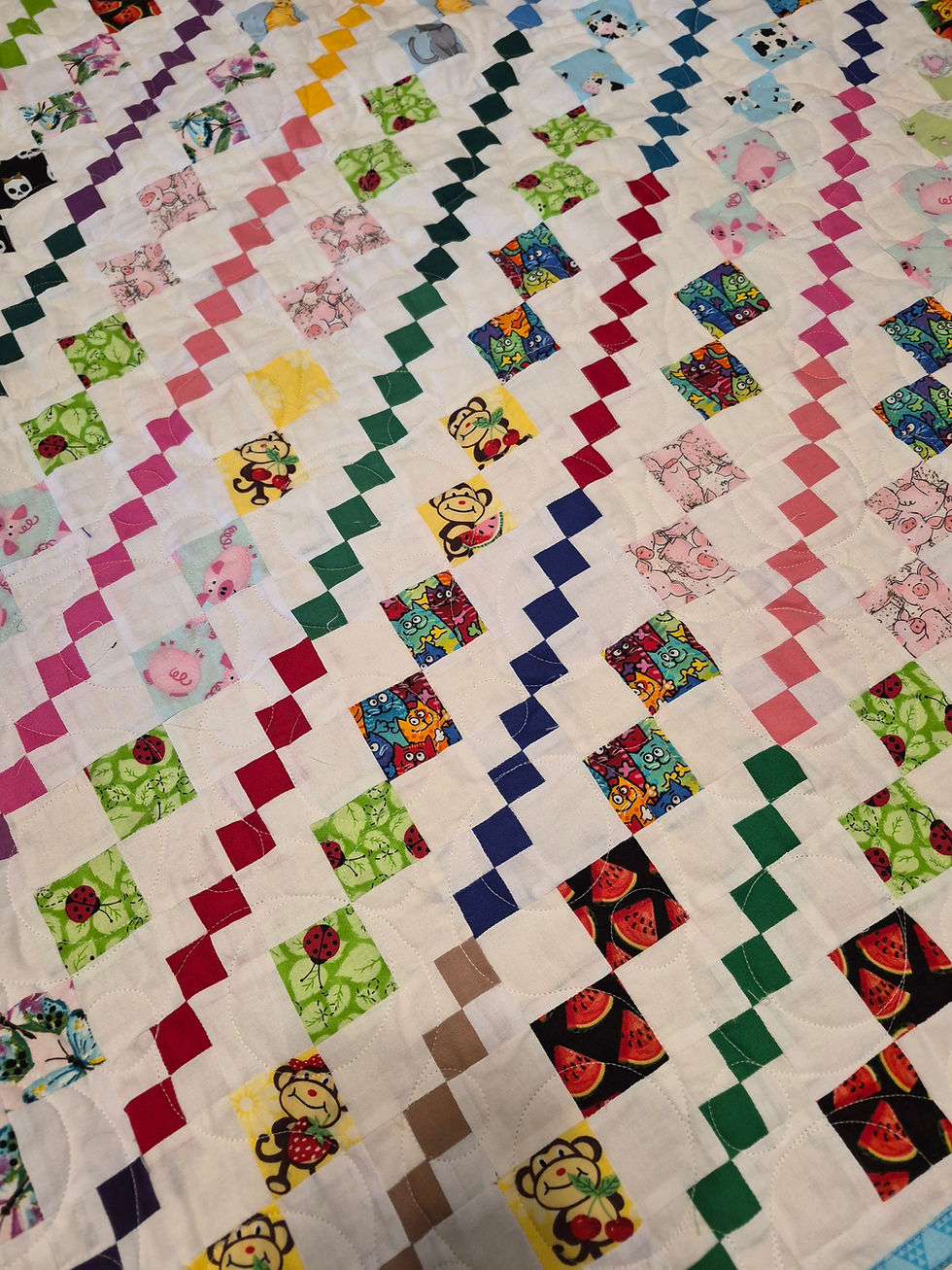
Recently, I completed a baby quilt featuring several carefully fussy-cut squares using children's prints. The block I had chosen for this quilt is a traditional quilt block known as as Carrie Nation.
Before long, the quilt had a name:
Carrie Is Fussy.
The name seemed perfect.
On one hand, it references the fussy-cut fabrics featured throughout the quilt. On the other, it tips its hat to one of the most determined, outspoken, and unforgettable women in American history: Carry Amelia Nation, better known as Carrie Nation.
As I stitched those carefully selected squares into place, I found myself wondering how much modern quilters really know about the woman behind the block name.
The answer led me down a fascinating historical rabbit hole involving quilting, social reform, women's activism, and one woman who believed so strongly in her cause that she became famous for smashing saloons with a hatchet.
Who Was Carrie Nation?
Carrie Nation was born Caroline Amelia Moore on November 25, 1846, in Garrard County, Kentucky. Throughout her life she was known by several variations of her name, including Carry Nation, Carrie Nation, and Carry A. Nation.
Her early years were far from easy.
Her family experienced financial struggles, frequent moves, and significant hardships. Her mother suffered from mental illness, and the instability of family life left a lasting impression on young Carrie. Eventually the family settled for a time in Missouri, and later moved to Texas during the Civil War years.
As a young woman, Carrie married Charles Gloyd, a physician and former Union soldier. Unfortunately, Gloyd struggled with alcoholism. Their marriage was short-lived, and he died in 1869 while Carrie was pregnant with their daughter. This devastating experience profoundly shaped her views about alcohol and would become a driving force behind her later activism.
Years later she married David Nation, a minister and attorney. The couple eventually settled in Kansas, where Carrie became increasingly involved in religious, charitable, and reform work.
The Temperance Movement
To understand Carrie Nation’s activism, it helps to understand the broader Temperance Movement.
Throughout the nineteenth century, many Americans were concerned about the effects of alcohol on families and communities. Women, in particular, often dealt with the consequences of alcoholism—poverty, domestic violence, and financial instability.
Organizations such as the Woman’s Christian Temperance Union (WCTU) advocated reducing or eliminating alcohol consumption. Carrie became involved with the movement and organized a local chapter in Medicine Lodge, Kansas.
What set her apart from most temperance reformers was her belief that traditional methods—meetings, petitions, and speeches—were not enough. She felt compelled to take more forceful action, a choice that remains controversial today.
The Woman With the Hatchet
The Woman With the Hatchet Today, Carrie Nation is best remembered for her dramatic attacks on saloons. Beginning around 1900, she entered establishments that served alcohol and destroyed bottles, mirrors, kegs, and bar fixtures. Her earliest raids involved tools such as bricks and rocks, but she later adopted the hatchet that became her trademark.
These events became known as"hatchetations."
Newspapers across the country eagerly covered her activities. Photographs of Carrie holding a Bible and a hatchet became some of the most recognizable images of the era.
While some viewed her as a dangerous extremist, others saw her as a courageous advocate for women and families.
Depending on whom you asked, Carrie Nation was either a menace to public order or a fearless defender of the home.

More Than a Saloon Smasher
Popular history often reduces Carrie Nation to a caricature: an angry woman with a hatchet.
The reality was much more complicated.
She devoted significant energy to charitable work and community service. In Kansas she organized efforts to provide clothing and assistance to families in need. She also established a shelter for wives and children affected by alcoholism, something historians have described as an early precursor to modern domestic violence shelters. Learning this endeared her to me, this is a cause and work that is very close to my heart.
She advocated for women's rights and supported women's suffrage at a time when women still lacked the right to vote.
Whether or not one agrees with her methods, it is difficult to deny that Carrie Nation was a woman who believed deeply in her convictions and refused to remain silent.
Carrie Nation and Quilting
Like many traditional quilt block names, the exact connection between Carrie Nation and the quilt block that bears her name is not entirely clear.
Quilt blocks have long reflected current events, famous people, local stories, and popular culture. During the late nineteenth and early twentieth centuries, quilt designers frequently named patterns after well-known public figures.
Given Carrie Nation's national fame, it is not surprising that a quilt block eventually came to carry her name.
For quilters today, the block serves as a reminder that quilts are more than fabric and thread. They are historical records, preserving stories that might otherwise be forgotten.
Why I Called My Quilt "Carrie Is Fussy"
Unlike the historical Carrie Nation, my quilt isn't carrying a hatchet.
It is carrying animals, storybook prints, playful colors, and a collection of carefully selected fussy-cut squares.
If you've ever spent time fussy cutting, you know it requires patience. You aren't simply cutting fabric.
You're choosing exactly which character, animal, flower, or motif appears in each square. You're deciding what deserves center stage.
Every block becomes a tiny frame.
Every cut matters.
As I worked on this baby quilt, I found myself paying attention to every little detail. Which animal should go here? Which character belongs there? Should this square be centered differently?
Before long, the phrase"Carrie Is Fussy" popped into my head.
The name made me laugh, and it stuck.
It felt like a lighthearted nod to both the quilting technique and the determined woman whose name has lived on through quilt history.
The Art of Fussy Cutting
For quilters unfamiliar with the term, fussy cutting is the process of selectively cutting fabric to showcase specific motifs.
Rather than cutting pieces in a standard continuous sequence, the quilter intentionally centers a design element within each patch.
Fussy cutting is especially popular with:
Children's fabrics
Novelty prints
Reproduction fabrics
Animal prints
Floral fabrics
Storybook fabrics

The technique can transform an ordinary block into something truly special.
It is also one of those details that recipients may not immediately notice but that fellow quilters instantly appreciate.
Making the Carrie Nation Quilt Block
I dug into my scraps, finding some from dresses made when the girls were small, some from when I sewed for the grandbabies when they were little. Sadly they are all "too big" for these fabrics now. However, my boss and his wife are expecting another little one any day now, so it seemed a great time to use these up.
Some of the fabrics worked betteer for this than others. I paired them with solid scraps
to complete the blocks. I made the 6" block size, and am providing cutting instructions for that size here.
I used a six block by six bloxk layout, and added a small one inch white border.
Knowing that I would not have time to quilt it before the baby comes I took it to the Corn Wagon Quilt Company to have it machine quilted.

For each Carrie Is Fussy 6" block cut:
8 "A" 2" squares (white)
8 "C" 1 1/4" squares (white)
4 "B" 2" fussy cut squares of novelty fabric
8 "D" 1 1/4" squares of coordinating solid cotton
I just used scraps, so calculating yardage is a rough estimate. For the 6x6 block layout you will need 288 2"squares and 1 1/4" squares of the white.
Of course you do not need to fussy cut. Here are some larger blocks I am piecing for a bed size quilt as well as another sample layout.


Why Historical Quilt Blocks Matter
One reason I love researching traditional quilt blocks is that they connect us to real people and real history.
Some blocks commemorate pioneer journeys.
Some honor politicians or activists.
Others preserve community memories that might otherwise disappear.
The Carrie Nation block reminds us that quilts often tell stories about the world beyond the sewing room.
They capture the concerns, dreams, controversies, and personalities of their time.
Every time we make one of these traditional blocks, we participate in a conversation that spans generations.
Remembering Carrie Nation Today
More than a century after her death in 1911, Carrie Nation remains one of the most recognizable figures of the Temperance Movement.
Historians continue to debate her legacy.
Some celebrate her activism and her willingness to confront social problems that many preferred to ignore.
Others criticize her tactics and question the effectiveness of her methods.
Regardless of where one stands, few would argue that she lacked determination.
She lived during a period when women were often expected to remain quiet and deferential. Carrie Nation did exactly the opposite.
She made herself impossible to ignore.
A Quilt, a Name, and a Story

My baby quilt may not solve any great social issue, and fortunately no hatchets were involved in its creation.
But naming it Carrie Is Fussy reminded me of something I love about quilting.
Every quilt has a story.
Sometimes that story comes from the fabric.
Sometimes it comes from the pattern.
Sometimes it comes from history.
And sometimes it comes from a fascinating woman who lived more than a century ago and refused to let anyone tell her to sit quietly in the corner.
As for my quilt, I think Carrie would probably appreciate the careful attention to detail.
After all, she never seemed like someone who accepted anything less than exactly what she wanted.
Sources & Further Reading
https://www.history.com/articles/carry-nation-temperance-prohibition-alcohol
https://www.ebsco.com/research-starters/history/carry-nation
https://archive.org (search for The Use and Need of the Life of Carry A. Nation by Carry A. Nation)
Primary Sources


Comments